
Clothing Care: Tips to Extend the Life of Your Luxury Accessories
Estimated reading time: 27 minutes
Table of contents
- The Ultimate Guide to Caring for Luxury Fashion & Accessories
- Before You Clean Anything: Know What You’re Caring For
- Your Luxury Fashion Care Kit: What You Actually Need
- The Luxury Material Care Cheat Sheet
- How to Care for Luxury Leather Accessories
- How to Clean Smooth Leather at Home
- Should You Condition a Luxury Leather Bag?
- What If Your Leather Bag Gets Wet?
- What About Lambskin?
- How to Keep a Luxury Handbag in Shape
- How to Care for Suede and Nubuck
- How to Brush Suede Correctly
- What Happens If Suede Gets Wet?
- How to Protect Suede From Rain
- Patent Leather: Glossy Doesn’t Mean Indestructible
- How to Clean Patent Leather
- Why Does Patent Leather Become Sticky?
- Raffia and Woven Luxury Bags: Treat the Weave With Respect
- Silk: Prevention Is Better Than Stain Removal
- How to Protect Silk Before You Wear It
- Can You Wash Silk at Home?
- Can You Steam or Iron Silk?
- What If Silk Gets Stained?
- Wool: The Luxury Fabric That Often Needs Less Washing
- Cashmere: Why Does Expensive Cashmere Still Pill?
- How Often Should Cashmere Be Washed?
- Should Cashmere Be Hung or Folded?
- How to Protect Cashmere and Wool From Moths
- Luxury Accessories and Perfume: An Overlooked Risk
- Prevent Colour Transfer Before It Happens
- How to Care for Luxury Shoes
- What If Luxury Shoes Get Wet?
- Small Leather Goods Need Care Too
- Protect Hardware, Embroidery and Embellishments
- What to Do When Something Spills on Your Luxury Accessory
- Household Products You Should Not Automatically Use on Luxury Fashion
- How to Store Luxury Handbags Correctly
- Should Luxury Bags Be Stored in Plastic?
- How Climate Affects Luxury Accessories
- How to Store Different Luxury Materials
- How to Travel With Luxury Accessories
- When Should You Repair a Luxury Accessory?
- A Simple Luxury Accessory Maintenance Schedule
- Before You Buy a High-Maintenance Luxury Accessory
- Does Expensive Clothing and Accessories Actually Last Longer?
- How Proper Care Can Improve Longevity
- The Most Common Luxury Fashion Care Mistakes
- The Golden Rules of Luxury Accessory Care
- Luxury Maintenance FAQ
- The Real Secret to Luxury Fashion Care
The Ultimate Guide to Caring for Luxury Fashion & Accessories
You finally buy the piece you’ve been thinking about for months.
Then comes the strange part of luxury ownership: you’re afraid to use it.
What if rain hits the suede?
What if coffee spills on the silk?
Why is your expensive cashmere already developing little pills?
Can you clean the leather yourself, or will the wrong product permanently change its finish?
What if your beautiful handbag loses its shape?
These aren’t unreasonable concerns. Luxury fashion may be made with better materials and exceptional craftsmanship, but luxury does not mean indestructible.
Leather can scratch. Suede can react badly to moisture. Patent leather can suffer from colour transfer. Raffia can lose its shape when crushed. Silk can stain. Cashmere can pill through ordinary friction. Even a beautifully made accessory can age badly if it is repeatedly exposed to heat, humidity, sunlight, cosmetics, moisture or inappropriate cleaning.
The good news is that much of this damage is preventable.
You don’t need to treat your wardrobe like a museum collection. You simply need to understand what each material needs—and what it absolutely does not.
This guide brings together practical luxury clothing care, handbag care, shoe care, fabric maintenance, storage and precaution tips for the materials represented across My Famille’s fashion collection, including leather, suede, patent leather, raffia, silk, wool and cashmere.
The goal isn’t to keep your favourite pieces looking untouched forever.
It’s to help them age beautifully.
Before You Clean Anything: Know What You’re Caring For
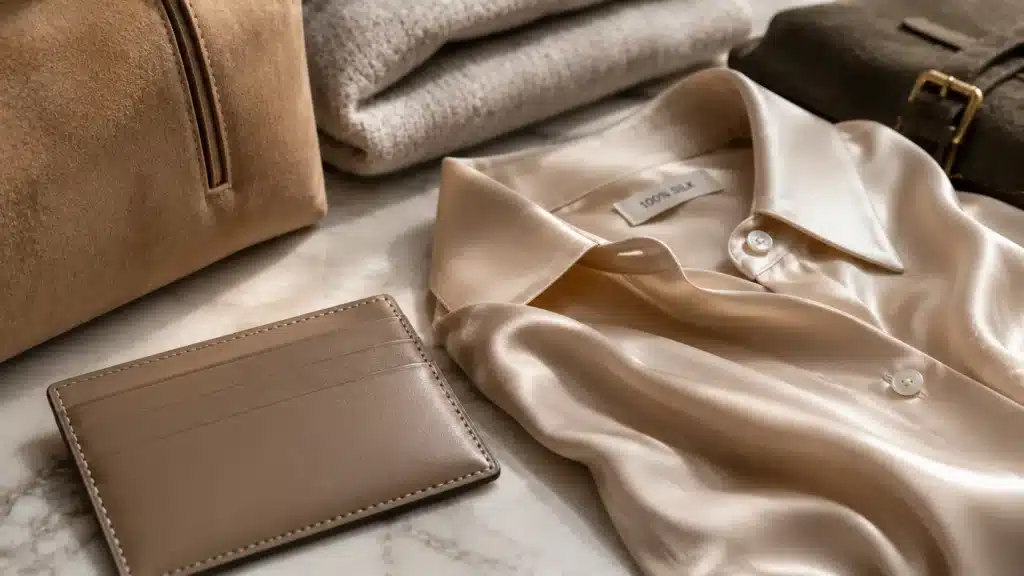
The first rule of luxury accessory care is simple:
Never start with the cleaning product. Start with the material.
A smooth calfskin handbag, lambskin shoe, suede pump and patent-leather accessory may all be made from leather, but they do not necessarily respond to the same treatment.
The same is true of clothing.
Cashmere, wool and silk each have different fibre characteristics and different tolerances for washing, heat, friction and moisture.
Even two pieces made from the same material can require different treatment because of their dye, construction, finish, lining or embellishments.
Before attempting DIY maintenance, check:
- The care label
- Fibre composition
- Material and finish
- Manufacturer instructions
- Whether different materials are combined
- Whether the item has embroidery, sequins, crystals or other embellishments
- Whether professional cleaning is recommended
If the manufacturer’s instructions conflict with a general internet tip, the manufacturer’s instructions win.
That’s especially important when you’re dealing with an expensive or irreplaceable piece.
Your Luxury Fashion Care Kit: What You Actually Need
You don’t need a cupboard full of expensive cleaning products.
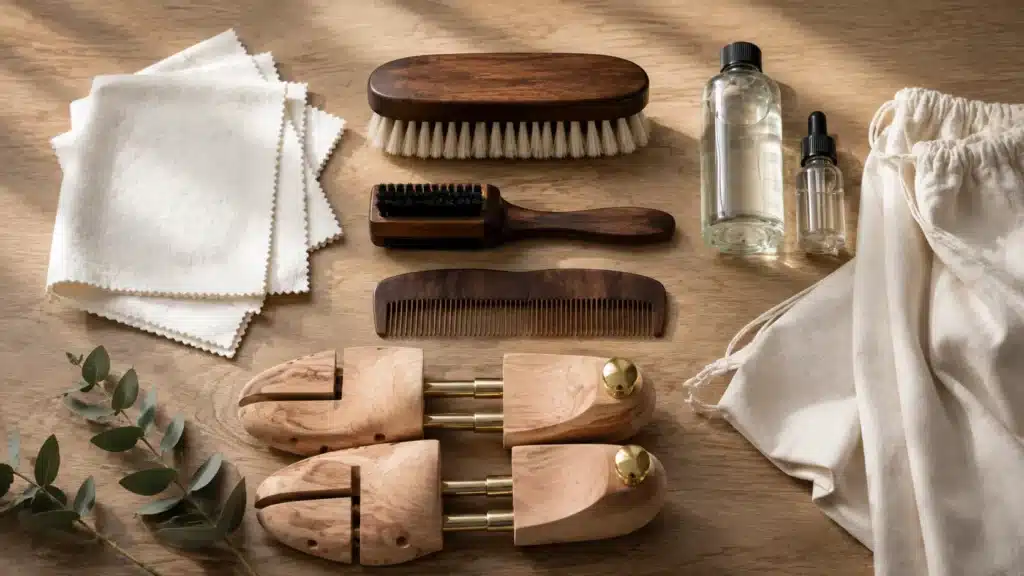
A small collection of appropriate tools is enough for most routine maintenance:
- Soft, lint-free microfiber cloths
- A soft clothing brush
- A dedicated suede or nubuck brush
- A cashmere comb
- Appropriate shoe trees
- Suitable tissue paper for supporting handbags
- Breathable dust bags
- Garment bags
- Manufacturer-approved leather-care products
- Material-specific cleaning products
The important word is appropriate.
Avoid assuming that every product labeled “leather cleaner” is suitable for all leather items. Standard conditioners should never be applied to suede, and household detergents aren’t safe just because they worked on other fabrics. This way, each sentence begins differently and the Yoast issue is resolved.
Some professional luxury-care systems explicitly exclude suede, nubuck, embellished surfaces and cracked vintage leather from products designed for smooth finished leather.
When you’re uncertain, less intervention is usually safer than enthusiastic experimentation.
The Luxury Material Care Cheat Sheet
Before going into each material in detail, here’s the quick version.
| Material | Biggest concerns | What helps | What to avoid |
|---|---|---|---|
| Smooth leather | Moisture, scratches, heat | Gentle cleaning, appropriate care products, correct storage | Harsh cleaners, soaking, excessive conditioning |
| Lambskin | Scratches, oils, friction | Gentle handling and soft cloths | Abrasion, over-cleaning |
| Suede | Water, stains, colour transfer | Dry brushing, careful storage | Soaking, harsh scrubbing, ordinary leather creams |
| Patent leather | Colour transfer, heat, finish damage | Soft cloth and material-specific care | Abrasives, prolonged heat/sun, unsuitable products |
| Cashmere | Friction, pilling, moths | Gentle cleaning, combing, folding | Pulling pills, excessive washing |
| Silk | Stains, heat, incorrect washing | Care-label-specific cleaning, careful storage | Rubbing, bleach, high heat |
| Wool | Shrinkage, friction, moths | Airing, appropriate cleaning, folding where suitable | Hot water, excessive washing |
| Raffia | Moisture, crushing, snagging | Dry storage, gentle handling | Soaking, overloading, pulling fibres |
| Embellishments | Friction and snagging | Separate storage | Stacking, rough fabrics, aggressive cleaning |
Think of this as your luxury accessory maintenance map. The detailed sections below explain how to use it.
How to Care for Luxury Leather Accessories
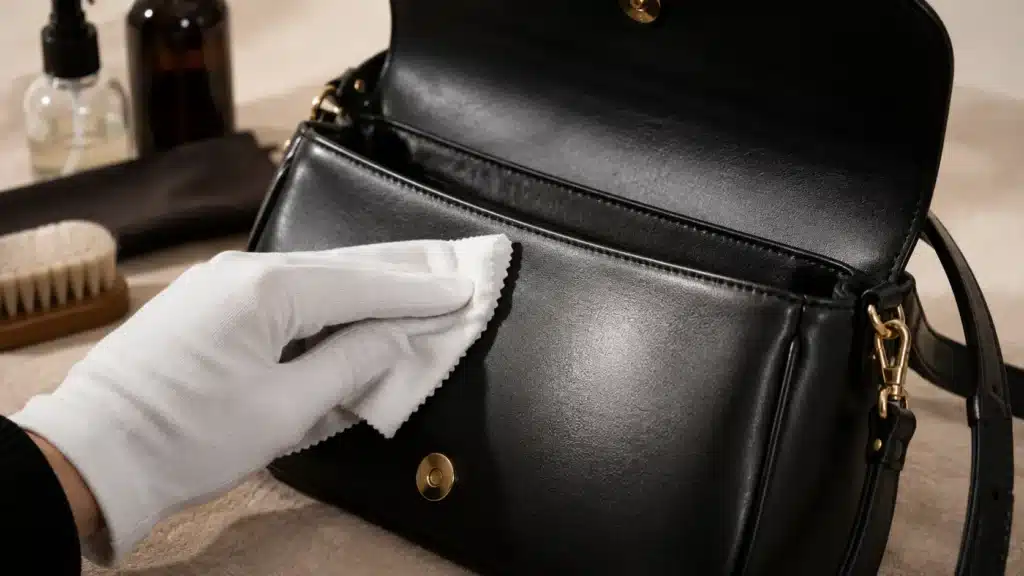
Leather is durable, but “durable” doesn’t mean “maintenance-free.”
My Famille’s fashion assortment includes luxury leather accessories such as the Prada 2002 Re-Edition Leather Shoulder Bag, along with numerous leather shoes and other accessories.
The first thing to understand is that leather is not one single material.
Depending on the item, you may encounter smooth calfskin, lambskin, pebbled leather, coated leather, untreated leather, patent leather, suede or nubuck.
Each behaves differently.
What can damage leather?
Common risks include:
- Water
- Humidity
- Direct sunlight
- Heat
- Perfume
- Cosmetics
- Body oils
- Abrasive surfaces
- Repeated friction
- Incorrect cleaning products
- Excessive conditioning
- Poor storage
CHANEL advises protecting leather handbags from prolonged sunlight and humidity and avoiding contact with substances such as makeup and perfume.
How to Clean Smooth Leather at Home
For routine surface maintenance:
Step 1: Empty the item
Remove everything from the bag, including crumbs, receipts, pens and cosmetics.
Step 2: Remove loose dust
Use a clean, soft microfiber cloth.
Don’t begin rubbing while dirt and grit are still sitting on the surface because those particles can create additional abrasion.
Step 3: Identify the finish
Before using any liquid or cream, confirm that the leather is suitable for that treatment.
Step 4: Spot-test
If a manufacturer-approved product is appropriate, test it somewhere discreet first.
Step 5: Apply minimally
Use a small amount on the cloth rather than flooding the leather.
Step 6: Let it dry naturally
Don’t speed up the process with a hair dryer or heater.
Specialist leather-care guidance similarly stresses removing loose dirt first, using controlled moisture and avoiding harsh household chemicals.
Should You Condition a Luxury Leather Bag?
Not automatically.
This is one of the most important distinctions missing from many generic leather-care guides.
Conditioning can be appropriate for some unfinished or finished leathers, but it isn’t a universal requirement.
Before conditioning, ask:
- What type of leather is this?
- Does the manufacturer recommend conditioning?
- Is the surface already supple?
- Does the product match this finish?
- Have I tested it first?
Why over-conditioning can be a problem
Too much product can leave a surface:
- Greasy
- Sticky
- Darker than intended
- Prone to collecting dust
- Uneven in appearance
So don’t think:
“My expensive bag is dry, therefore it needs more conditioner.”
Think:
“What does this particular leather actually require?”
For products specifically designed for suitable finished leather, professional care systems also recommend spot-testing and clearly exclude materials such as suede, nubuck and cracked vintage pieces.
What If Your Leather Bag Gets Wet?
This is one of the most common luxury-accessory emergencies.
The instinct is often to dry it immediately.
Don’t use aggressive heat.
Instead:
- Gently blot away excess moisture.
- Use a clean, absorbent, non-abrasive cloth.
- Let the leather dry naturally.
- Keep it away from radiators, hair dryers and strong sunlight.
- Don’t immediately apply random oils, creams or polishes.
If the leather has developed significant staining, swelling, cracking or structural changes, stop experimenting and seek professional assessment.
What About Lambskin?
Lambskin deserves extra caution.
It is prized for its softness and supple feel, but that softness also means it can show marks and scratches more readily than tougher, more textured leathers.
CHANEL notes that its lambskin is treated minimally to preserve its natural suppleness and advises gentle handling.
For lambskin:
- Keep hands clean before handling.
- Avoid rough surfaces.
- Don’t drag the bag across tables or floors.
- Keep jewellery and sharp objects away from it.
- Don’t overload it.
- Avoid aggressive rubbing.
- Don’t experiment with strong cleaners.
A little prevention is much safer than trying to erase a deep scratch later.
How to Keep a Luxury Handbag in Shape
A handbag can be perfectly clean and still look tired because its structure has been compromised.
Avoid overfilling
Too much weight can stretch handles and alter the silhouette.
CHANEL specifically advises against overfilling handbags to preserve their shape.
Organise the interior
Keep pens, makeup and other potentially damaging objects inside pouches.
A loose lipstick or uncapped pen can cause considerably more damage than ordinary daily wear. Professional restoration specialists specifically identify ink and food/liquid stains among difficult handbag problems and advise keeping potentially damaging objects contained.
Support the shape during storage
Use suitable, clean, undyed tissue or another appropriate support material.
Don’t stuff a handbag so tightly that you’re stretching the leather.
The objective is to support its original shape, not force it into a new one.
How to Care for Suede and Nubuck
Suede is one of the materials people most often hesitate to buy.
The concern is understandable.
Its soft, velvety surface can be more vulnerable to moisture, staining, abrasion and colour transfer than many smooth leathers.
My Famille’s luxury footwear assortment includes designer pieces incorporating suede and mixed materials, making proper suede care particularly relevant.
Is suede difficult to maintain?
It can be more demanding than smooth leather, but it isn’t impossible.
The key is understanding what not to do.
Burberry advises gentle brushing for suede and nubuck, warns against solvents and hard or wire brushes, and recommends protecting these materials from heat, direct sunlight and abrasive contact.
How to Brush Suede Correctly
For ordinary surface dirt:
- Make sure the suede is dry.
- Use a dedicated suede brush.
- Brush gently.
- Follow the direction of the nap where appropriate.
- Don’t repeatedly attack one area.
- Stop if the colour or texture starts changing.
Never treat suede like smooth leather
Avoid automatically applying:
- Leather cream
- Leather conditioner
- Greasy oils
- Standard shoe polish
Those products may change the nap or appearance.
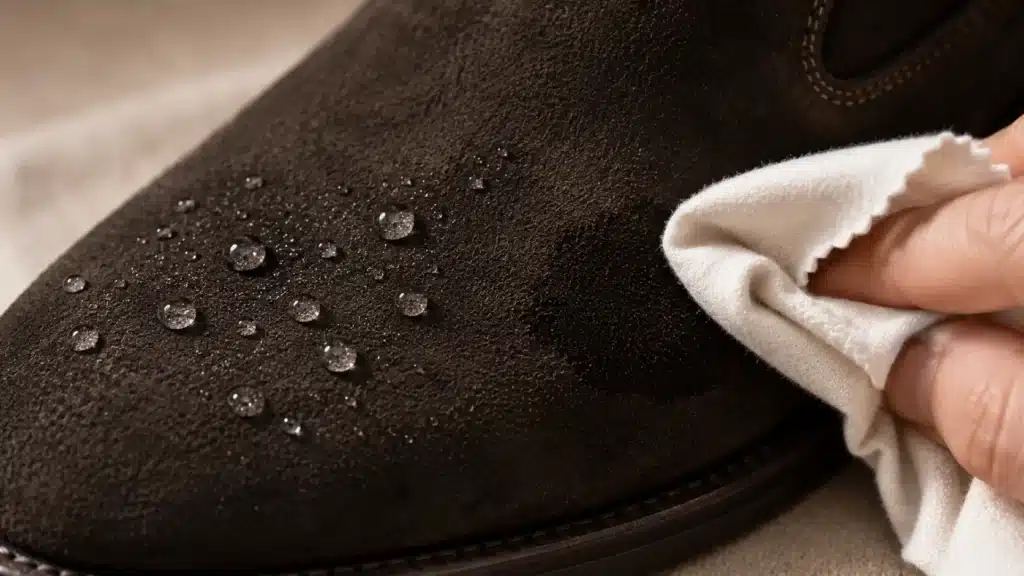
What Happens If Suede Gets Wet?
This is probably the biggest suede-care question.
The answer is:
Blot. Dry naturally. Don’t heat.
If suede becomes wet:
- Gently blot excess moisture.
- Don’t rub aggressively.
- Allow it to dry naturally.
- Keep it away from heaters and hair dryers.
- Once completely dry, gently restore the nap with an appropriate brush.
For deep staining, oil, heavy water damage or colour changes, professional cleaning is safer.
How to Protect Suede From Rain
If you know you’ll be walking through heavy rain, a delicate suede accessory may simply not be the right choice for that occasion.
That’s not a failure of the material.
It’s good wardrobe management.
If the manufacturer recommends a water-repellent treatment, use only a product intended for that material and follow its instructions.
Never assume that making suede “waterproof” is as simple as spraying it with any generic protector.
Patent Leather: Glossy Doesn’t Mean Indestructible
Patent leather has a coated, high-shine surface, which can make it look almost invulnerable.
It isn’t.
My Famille’s Miu Miu patent-leather slingback pumps are a good example of why this finish deserves its own care approach.
Patent leather can be affected by:
- Colour transfer
- Heat
- Sunlight
- Scratches
- Abrasive materials
- Improper cleaning
- Contact with dark dyes
CHANEL warns that light patent leather can be particularly vulnerable to colour transfer from dark materials and that excessive sunlight can alter its colour.
How to Clean Patent Leather
Follow the brand’s specific instructions.
For suitable patent footwear, CHANEL recommends gentle cleaning with a sponge and water with a gentle detergent, followed by drying with a soft cloth.
The important word is gentle.
Don’t:
- Scrub
- Use abrasive sponges
- Use ordinary leather polish without checking compatibility
- Apply random solvents
- Expose the item to high heat
Why Does Patent Leather Become Sticky?
Patent leather has a coated surface, and deterioration of that finish can create changes in texture.
If a patent item becomes unusually sticky:
Don’t keep applying products in an attempt to restore the shine.
The problem may be the coating itself rather than surface dirt.
At that stage, professional assessment is more appropriate.
Can patent leather peel?
If the coating itself is deteriorating, ordinary cleaning cannot necessarily reverse it.
This is an important distinction:
Cleaning removes dirt. Restoration addresses material deterioration.
Professional restoration specialists assess damaged finishes case by case rather than promising that every damaged surface can be returned to its original state. (FASHIONPHILE)
Raffia and Woven Luxury Bags: Treat the Weave With Respect
Raffia has become an important part of sophisticated resort and summer fashion because it combines natural texture with a relaxed, artisanal character.
My Famille’s Chloé Mifuko Bucket Bag, for example, combines a raffia body with cotton and leather components.
That combination creates a special care requirement.
Raffia is vulnerable to:
- Moisture
- Crushing
- Snagging
- Heavy loads
- Excessive friction
- Poor storage
How to maintain a raffia bag
- Remove surface dust gently.
- Use a soft brush where appropriate.
- Keep it dry.
- Avoid soaking.
- Don’t pull loose fibres.
- Don’t overload the bag.
- Keep it away from rough surfaces.
- Store it so the weave isn’t crushed.
What if a raffia strand comes loose?
Don’t immediately cut it.
And don’t pull it.
A loose strand may be superficial—or it may be connected to the structure of the weave.
For an expensive woven piece, professional repair is safer than turning a small loose fibre into a larger unravelled section.
Silk: Prevention Is Better Than Stain Removal
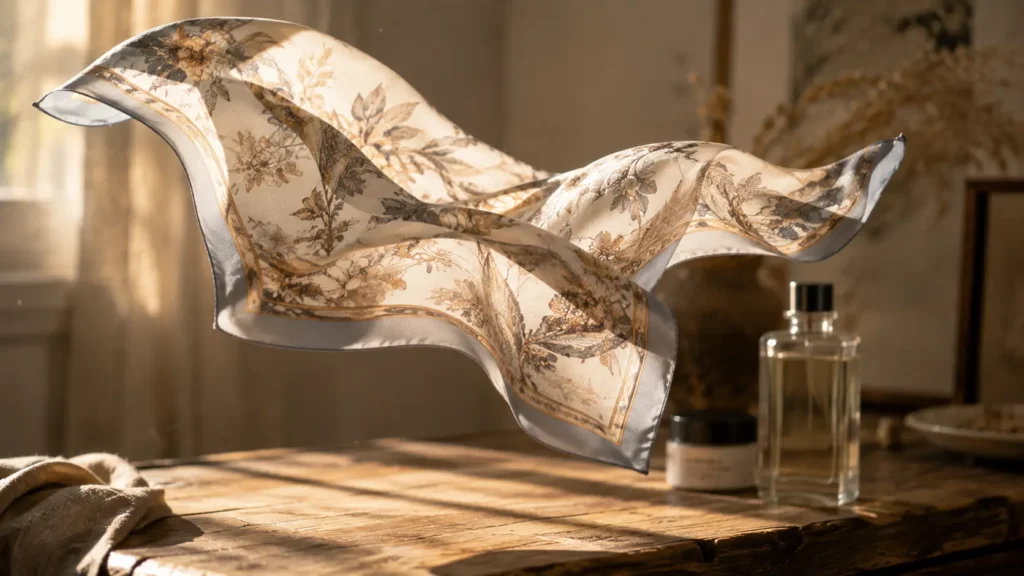
Silk is one of the easiest luxury materials to damage through an innocent mistake.
My Famille’s designer assortment includes silk pieces such as the Brunello Cucinelli Silk Blazer and other silk garments.
The biggest silk-care mistake is assuming:
“It’s fabric, so I’ll just wash it.”
Not necessarily.
The correct method depends on the specific garment.
Burberry’s current care guidance treats silk separately from other fabrics and recommends following its cleaning instructions rather than treating it as an ordinary washable fabric.
How to Protect Silk Before You Wear It
Think prevention.
Keep perfume away from the fabric
Apply perfume to your skin and allow it to settle before dressing.
Let skincare dry
Moisturisers, oils and sunscreens can interact with delicate materials.
Be careful with jewellery
Rough edges can snag silk.
Watch handbag straps
Repeated friction in one area can weaken delicate fabric.
Avoid rough surfaces
Silk doesn’t need to be dramatically damaged to show wear. Repeated friction can gradually affect it.
Can You Wash Silk at Home?
Sometimes—but only when the garment’s care instructions allow it.
Never assume that every silk garment is hand-washable.
If the label permits washing:
- Follow the stated temperature.
- Use the recommended detergent.
- Avoid aggressive rubbing.
- Don’t wring or twist unless the instructions specifically allow it.
- Follow the label for drying and pressing.
If the label requires professional cleaning, use a reputable specialist.
Can You Steam or Iron Silk?
Again, follow the garment’s care instructions.
If heat treatment is permitted:
- Use the recommended temperature.
- Avoid excessive direct heat.
- Don’t press aggressively.
- Use appropriate protection if the manufacturer recommends it.
The safest approach is not to invent your own steaming or ironing protocol for an expensive silk piece.
What If Silk Gets Stained?
The temptation is to attack the stain immediately.
Resist that instinct.
Instead:
- Identify the material.
- Identify the stain if possible.
- Blot rather than rub.
- Don’t add random household chemicals.
- Check the care instructions.
- Seek professional cleaning for significant or uncertain stains.
Rubbing can spread the stain and damage the fibres simultaneously.
Wool: The Luxury Fabric That Often Needs Less Washing
Wool is often treated as if it needs to be washed after every wear.
It usually doesn’t.
My Famille’s collection includes designer wool coats, cardigans, skirts and knitwear, so understanding wool maintenance is useful for anyone buying premium wool garments.
Between wears:
- Air the garment.
- Brush away surface dust where appropriate.
- Check for stains.
- Let it rest.
- Store it correctly.
Burberry’s care guidance recommends cleaning cashmere and wool only when necessary.
Why avoid unnecessary washing?
Every cleaning cycle places some degree of stress on fibres, dyes and construction.
If a garment is clean and simply needs airing, washing may be unnecessary.
Watch out for heat
Excessive heat can contribute to shrinkage or distortion.
Always follow the garment’s instructions.
Cashmere: Why Does Expensive Cashmere Still Pill?
This is probably the question luxury knitwear owners ask most often.
Yes, even expensive cashmere can pill.
Pilling happens when loose fibres gather through friction.
Common friction points include:
- Underarms
- Sides of garments
- Under coat sleeves
- Around handbag straps
- Against seat belts
- Where two layers rub together
So pilling is not automatically evidence that the cashmere is poor quality.
How to Remove Pilling From Cashmere
Use a suitable cashmere comb or specialist fabric tool.
Work gently.
Don’t pull pills out with your fingers because doing so can pull additional fibres from the garment.
The goal is to remove loose surface fibres—not to repeatedly shave the garment.
How can you reduce cashmere pilling?
You can reduce unnecessary friction by:
- Avoiding rough outer layers
- Rotating garments
- Being conscious of handbag straps
- Following the care label
- Storing cashmere correctly
How Often Should Cashmere Be Washed?
There is no universal number.
Wash according to:
- The care label
- How heavily the garment was worn
- Whether it actually needs cleaning
- The manufacturer’s instructions
Burberry recommends cleaning cashmere only when necessary.
If the garment is clean but simply needs refreshing, airing it may be preferable to unnecessary washing.
Should Cashmere Be Hung or Folded?
For delicate knitwear, folding is generally the safer default when the garment’s weight makes hanging likely to stretch or distort it.
Store it:
- Clean
- Completely dry
- Folded
- In a breathable environment
- Away from prolonged direct sunlight
- Protected against moths
The exact storage method should still follow the garment’s construction and care instructions.
How to Protect Cashmere and Wool From Moths
Moths are attracted to natural animal fibres, particularly when garments are stored for long periods.
The most important preventive steps are:
- Store garments clean.
- Keep storage dry.
- Inspect periodically.
- Avoid storing damp clothing.
- Keep closets clean.
- Use suitable pest-control measures where needed.
Don’t rely on fragrance alone as a guarantee of protection.
The goal is to create an environment where pests have fewer opportunities to thrive.
Luxury Accessories and Perfume: An Overlooked Risk
Your perfume may smell wonderful.
That doesn’t mean your handbag wants to smell like it.
Repeated contact with perfume, skincare, cosmetics and other chemical products can affect certain materials and finishes.
CHANEL specifically advises protecting handbags from makeup, perfume and chemical substances.
Better habit:
- Apply skincare.
- Allow it to absorb.
- Apply perfume.
- Let it dry.
- Then handle delicate accessories.
Never deliberately spray perfume onto:
- Leather
- Suede
- Patent leather
- Silk
- Embellished accessories
Prevent Colour Transfer Before It Happens
Colour transfer is particularly frustrating because the damage can appear after repeated contact rather than immediately.
Be careful with combinations such as:
- Dark denim + light leather
- Dark leather + pale patent leather
- Dark suede + light fabric
- Strongly dyed clothing + light handbags
CHANEL specifically warns about prolonged contact between light and dark colours.
Be especially cautious with:
- White
- Cream
- Beige
- Nude
- Pale pink
- Light grey
If you’re wearing dark denim with a pale luxury bag, the safest strategy is simply to minimise prolonged rubbing between the two.
How to Care for Luxury Shoes
Shoes arguably experience more physical stress than any other luxury accessory.
They encounter:
- Pavement
- Dust
- Water
- Friction
- Bending
- Pressure
- Heat
- Humidity
Rotate your shoes
Don’t wear the same luxury pair continuously if you can avoid it.
CHANEL recommends alternating shoes rather than wearing the same pair on consecutive days.
This gives them time to air and recover.
Use a shoehorn
A shoehorn can reduce unnecessary stress on the heel structure when putting shoes on.
Use suitable shoe trees
Where appropriate, shoe trees help support shape and allow the shoe to air.
CHANEL recommends allowing shoes to air on a shoe tree before storing them in a dry environment.
What If Luxury Shoes Get Wet?
Do not place leather items beside a heater, and avoid blasting them with a hair dryer. Keeping them under direct sunlight is equally damaging.
Instead:
- Dab away excess moisture.
- Allow them to dry naturally.
- Maintain their shape appropriately.
- Follow the material-specific care instructions.
CHANEL’s footwear guidance specifically recommends natural drying away from high temperatures and direct sunlight.
Small Leather Goods Need Care Too
Luxury maintenance doesn’t end with handbags.
Wallets, cardholders, belts and pouches are exposed to constant pressure and friction.
For wallets and cardholders:
- Don’t overfill slots.
- Don’t force cards into tight compartments.
- Keep coins separate where possible.
- Avoid loose pens or sharp objects.
- Keep them away from moisture.
- Store them appropriately when not in use.
The same principle applies to belts.
Repeatedly bending a belt at exactly the same point, crushing decorative elements or storing it beneath heavy objects can accelerate wear.
Protect Hardware, Embroidery and Embellishments
A luxury accessory can have excellent leather and still be damaged by careless handling of its decorative components.
CHANEL specifically advises protecting embellished and embroidered bags from prolonged friction with delicate fabrics such as wool, silk and tweed.
For embellished pieces:
- Store them separately.
- Don’t stack heavy accessories on top.
- Protect chains from rubbing against decorative surfaces.
- Don’t pull loose threads.
- Don’t glue detached embellishments without understanding the construction.
- Avoid aggressive cleaning.
Sometimes the safest maintenance technique is simply giving the piece enough space.
What to Do When Something Spills on Your Luxury Accessory
This deserves its own rulebook.
First: Don’t panic.
Second: Don’t rub.
Blotting is usually safer than rubbing because aggressive friction can spread the stain and damage the material.
Third: identify the material.
Ask:
- Is it leather?
- Suede?
- Patent leather?
- Silk?
- Cashmere?
- Raffia?
Fourth: identify the substance.
Is it:
- Water?
- Oil?
- Makeup?
- Food?
- Ink?
- Wine?
Fifth: stop before improvising.
Don’t reach for a household chemical simply because someone online used it on another material.
Professional restoration specialists identify ink, gum and heavy food/liquid stains among particularly difficult handbag problems.
If you’re unsure, professional cleaning is often cheaper than a permanent mistake.
Household Products You Should Not Automatically Use on Luxury Fashion
This is where DIY becomes dangerous.
Do not assume that any of the following are appropriate simply because they are common household products:
- Bleach
- Acetone
- Nail-polish remover
- Alcohol
- Strong detergent
- Abrasive sponges
- Household disinfectants
- Generic oils
- Random leather polish
- Harsh solvents
- “Miracle” stain removers
The rule isn’t that every one of these substances is universally harmful in every conceivable application.
The rule is:
Don’t put an unapproved household chemical on an expensive fashion material unless the manufacturer specifically says it is suitable.
For example, Louis Vuitton’s care instructions for certain leather goods specifically caution against soap and solvents, illustrating why generic cleaning advice cannot safely be applied to every luxury finish.
How to Store Luxury Handbags Correctly

Storage is maintenance.
When you’re not using an expensive accessory, don’t simply throw it into the back of the closet.
Before storing:
- Empty it completely.
- Remove dust and debris.
- Make sure it is dry.
- Support the shape appropriately.
- Protect chains and hardware.
- Place it in its suitable dust bag.
- Give it enough space.
CHANEL recommends storing handbags upright in their pouch and wrapping straps or chains with tissue where appropriate.
Should Luxury Bags Be Stored in Plastic?
For long-term storage, don’t automatically seal natural-material luxury accessories in airtight plastic.
A suitable breathable dust bag is generally preferable where the manufacturer provides one.
Why?
Because trapped moisture can contribute to unpleasant odours and, in sufficiently damp environments, mould.
This is particularly important in humid climates.
How Climate Affects Luxury Accessories
Your storage environment matters almost as much as your cleaning routine.
Humidity
Excess moisture can contribute to:
- Mould
- Musty odours
- Material deterioration
Heat
Excessive heat can affect:
- Leather
- Coatings
- Adhesives
- Shape
- Finishes
Sunlight
Prolonged exposure can contribute to fading and colour changes.
CHANEL and Burberry both recommend avoiding prolonged direct sunlight for relevant luxury materials. (CHANEL)
Rain
Rain isn’t automatically catastrophic, but leaving a luxury accessory wet in a closed space is a poor idea.
Dry appropriately before storage.
How to Store Different Luxury Materials
Leather bags
Store upright where appropriate, supported, protected and away from excessive light and humidity.
Suede
Keep dry, protected from crushing and away from dark materials that could transfer colour.
Patent leather
Keep surfaces separated and away from excessive heat and sunlight.
Cashmere and wool
Keep clean, dry and appropriately folded or stored according to the garment’s construction.
Silk
Protect from crushing, excessive light and unsuitable moisture.
Raffia
Keep dry, lightly supported and uncompressed.
Shoes
Allow them to air, use suitable shoe trees where appropriate and store them somewhere dry and stable.
How to Travel With Luxury Accessories
Travel creates risks your closet doesn’t.
Before travelling:
- Clean and dry your pieces.
- Empty handbags.
- Protect delicate surfaces.
- Support structured bags.
- Separate jewellery and hardware.
- Keep cosmetics in sealed pouches.
During travel:
- Protect bags from dirty floors.
- Don’t overload them.
- Keep liquids securely sealed.
- Avoid placing delicate accessories beneath heavy luggage.
- Keep valuable, fragile pieces appropriately protected.
At the destination:
- Don’t store leather directly beside a humid bathroom.
- Don’t leave wet accessories packed inside luggage.
- Allow damp pieces to dry naturally.
- Keep delicate accessories away from direct sunlight.
A few minutes of preparation can prevent a surprisingly expensive travel mishap.
When Should You Repair a Luxury Accessory?
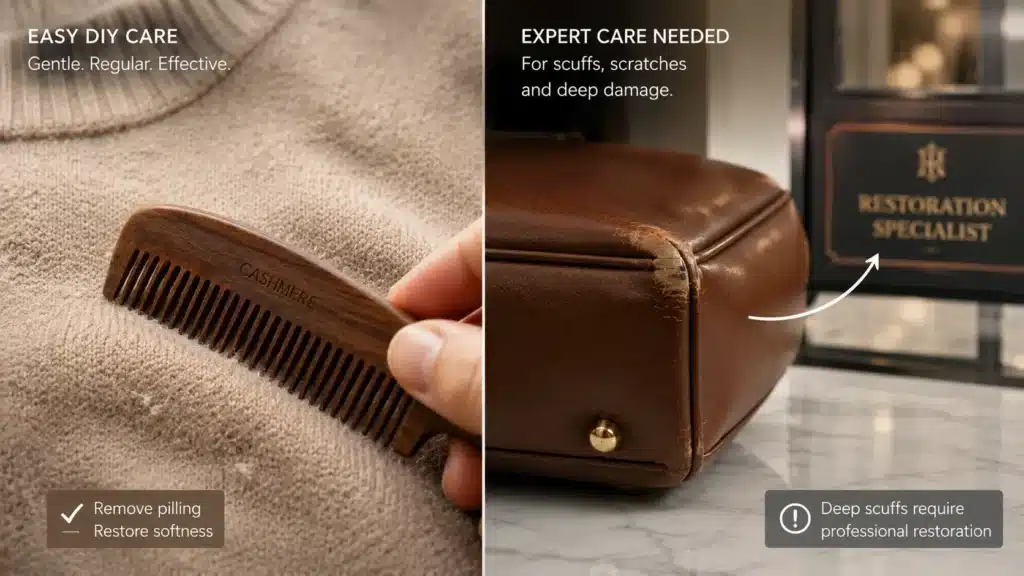
Don’t wait until a small problem becomes a major one.
Pay attention to:
- Loose stitching
- Fraying edges
- Cracked leather
- Detached handles
- Broken hardware
- Loose embellishments
- Opening seams
- Damaged soles
- Significant colour transfer
- Peeling finishes
DIY or professional?
A useful rule is:
Routine maintenance = DIY.
Structural or irreversible damage = professional.
DIY is generally appropriate for:
- Dust removal
- Gentle brushing
- Appropriate storage
- Basic shape support
- Manufacturer-approved routine care
- Cashmere combing
Professional help is preferable for:
- Deep stains
- Oil stains
- Ink
- Severe water damage
- Mould
- Major scratches
- Structural damage
- Cracking
- Damaged patent coatings
- Significant colour restoration
- Valuable embellished pieces
Professional restoration specialists assess difficult stains and damaged finishes on a case-by-case basis rather than treating every problem with the same cleaning method.
A Simple Luxury Accessory Maintenance Schedule
You don’t need to spend hours every week caring for your wardrobe.
After wearing
- Air the item.
- Remove visible dust.
- Empty handbags.
- Check for moisture.
- Check for fresh stains.
- Store correctly.
Every few wears
- Brush suitable suede.
- Inspect leather.
- Check cashmere for pilling.
- Inspect shoe soles and heels.
- Check straps, handles and hardware.
Once a month
- Inspect frequently used pieces.
- Review storage conditions.
- Look for early scratches.
- Check for colour transfer.
- Check delicate fabrics for signs of friction.
Seasonally
- Inspect pieces going into long-term storage.
- Check wool and cashmere for pests.
- Inspect leather and suede.
- Check woven bags for loose fibres.
- Arrange repairs before small problems become major ones.
Before You Buy a High-Maintenance Luxury Accessory
This is something luxury shoppers rarely consider.
Before buying an expensive piece, ask:
Does this material suit my lifestyle?
If you commute in heavy rain every day, a highly delicate suede accessory may require more thought than a weather-tolerant alternative.
Do I have time for maintenance?
Some pieces need more attention than others.
Can I store it properly?
A small apartment with a humid closet presents different challenges from a cool, dry wardrobe room.
Am I comfortable with professional cleaning?
Some materials aren’t good candidates for experimentation.
Will I actually wear it?
A beautiful accessory that spends its entire life hidden because you’re terrified of damaging it isn’t necessarily a successful purchase.
This doesn’t mean avoiding delicate luxury fashion.
It means buying with an understanding of the relationship between material, lifestyle and maintenance.
Does Expensive Clothing and Accessories Actually Last Longer?
Sometimes—but price alone doesn’t guarantee longevity.
A luxury piece may benefit from:
- High-quality materials
- Careful construction
- Better finishing
- Skilled craftsmanship
- Repairability
- Strong design
But every material still has physical limitations.
Cashmere can pill.
Silk can stain.
Suede can react to water.
Leather can scratch.
Patent coatings can deteriorate.
Raffia can snag.
So the better question isn’t:
“Is expensive fashion indestructible?”
It is:
“Is the material well made, appropriate for my use, and worth maintaining?”
That’s a much more useful way to evaluate luxury.
How Proper Care Can Improve Longevity
Good maintenance doesn’t stop natural ageing.
It reduces avoidable deterioration.
Compare two identical handbags.
One is:
- Overloaded
- Left in direct sunlight
- Exposed to rain
- Stored while damp
- Crushed in a closet
- Cleaned with unsuitable products
The other is:
- Used thoughtfully
- Kept away from unnecessary moisture
- Stored correctly
- Cleaned according to its material
- Inspected regularly
- Repaired when necessary
They may have started with identical craftsmanship.
They are unlikely to age identically.
Proper care can also help preserve condition, which can matter if you eventually decide to resell a luxury item. Specialist resale and restoration services explicitly connect condition and restoration with the preservation of luxury goods.
But don’t confuse maintaining condition with guaranteeing investment returns.
Not every luxury item appreciates in monetary value.
The Most Common Luxury Fashion Care Mistakes
If you remember nothing else, remember these.
Don’t use one cleaner on everything.
Material matters.
Don’t assume expensive cashmere won’t pill.
Friction still exists.
Don’t pull pills aggressively.
Use an appropriate tool.
Don’t scrub suede.
You can damage the nap.
Don’t heat wet leather or suede.
Natural drying is safer.
Don’t expose patent leather to dark dyes for prolonged periods.
Colour transfer can be difficult to reverse.
Don’t overfill handbags.
Shape matters.
Don’t leave loose pens and cosmetics inside bags.
They can create serious stains.
Don’t store luxury pieces while damp.
Moisture can create bigger problems later.
Don’t spray perfume directly onto fashion accessories.
Chemical exposure can affect certain materials.
Don’t experiment with viral cleaning hacks.
Your expensive handbag is not the place to test a five-minute internet trick.
Don’t ignore small damage.
Early repairs are usually easier than major restoration.
The Golden Rules of Luxury Accessory Care
If the entire guide had to be reduced to ten rules, they would be these:
1. Read the care label first.
2. Identify the material before cleaning.
3. Use the gentlest appropriate method.
4. Blot spills instead of aggressively rubbing them.
5. Keep leather, suede and delicate fabrics away from unnecessary heat and sunlight.
6. Store handbags supported, protected and uncompressed.
7. Keep cashmere and wool clean, dry and protected from pests.
8. Prevent perfume, cosmetics and dyes from contacting vulnerable materials.
9. Don’t confuse cleaning with restoration.
10. Know when to stop DIY care and call a professional.
Luxury Maintenance FAQ
The best approach is to care for each material according to its specific properties and care label. Leather, suede, silk, cashmere and wool can react very differently to water, heat, friction and cleaning products. Regular inspection, gentle handling, appropriate storage and avoiding unnecessary cleaning are the foundations of effective clothing care and can help reduce preventable damage over time.
Yes, even high-quality cashmere can develop pills because friction causes loose fibres to gather on the surface. Pilling commonly appears around areas that rub against coats, handbags, seat belts or other garments. It does not automatically indicate poor quality. For gentle cashmere care, use an appropriate cashmere comb rather than pulling pills by hand, and reduce unnecessary friction whenever possible.
A luxury leather handbag should be cleaned gently and according to its specific leather finish. Start by removing surface dust with a soft, lint-free cloth, then use only a manufacturer-approved leather-care product if one is recommended. Avoid soaking the leather, harsh household cleaners, excessive conditioner and direct heat. Proper leather bag care also includes protecting the handbag from prolonged sunlight, moisture and cosmetics.
Some silk garments can be washed at home, but you should never assume that all silk is washable. Always follow the individual care label because construction, dye and finishing can affect the appropriate method. If washing is permitted, use the recommended temperature and handling instructions without aggressive rubbing or wringing. For specialist-cleaning garments, professional silk clothing care is preferable to experimenting at home.
Luxury handbags and accessories should be stored clean, completely dry, protected from direct sunlight and away from excessive humidity. Structured handbags can be supported with suitable tissue or inserts to help retain their shape, while hardware should be protected from unnecessary rubbing. Breathable dust bags are generally preferable for long-term storage. Good storage is an important part of luxury accessory maintenance, not simply an organisational habit.
Prevention is the safest form of clothing care, particularly with light-coloured leather, suede and delicate fabrics. Keep perfume, cosmetics and skincare products from directly contacting vulnerable materials, and be cautious when pairing pale accessories with dark denim or strongly dyed clothing. Avoid placing luxury pieces on dirty or damp surfaces, and if something spills, blot rather than aggressively rubbing the affected area.
The Real Secret to Luxury Fashion Care
There is a point where luxury care stops being about cleaning and starts being about understanding. Cashmere may pill, while silk demands respect. Patent leather carries a delicate finish that requires protection, and suede simply does not enjoy rain. Leather can develop a beautiful patina but still needs sensible maintenance. Raffia should always be kept dry and uncrushed, and the shape of a handbag matters almost as much as its surface. Sometimes, the wisest DIY choice is recognizing when not to attempt it yourself.
Luxury fashion isn’t meant to be locked away because you’re frightened of using it.
A beautiful handbag should go places.
A silk piece should be worn.
Cashmere should be enjoyed.
Shoes should collect memories.
A little natural wear isn’t failure. In many materials, it becomes part of the object’s story.
The goal is not to make your favourite pieces look untouched forever.
The goal is to give them the care they need to remain beautiful, functional and wearable for as long as possible.
Because the best luxury accessory isn’t the one that spent ten years sitting safely in a box.
It’s the one you loved enough to wear—and cared for well enough to keep.









Leave a comment